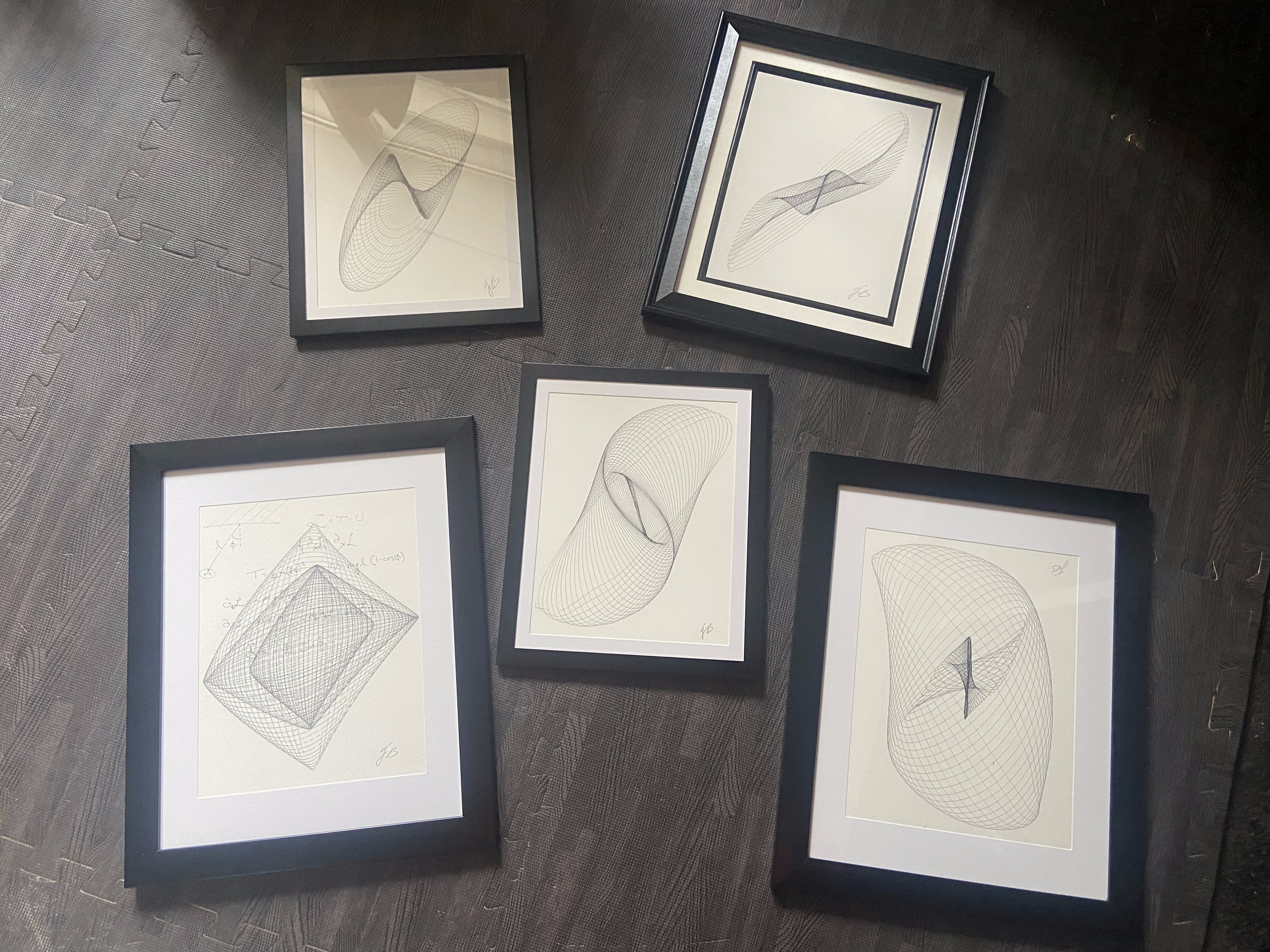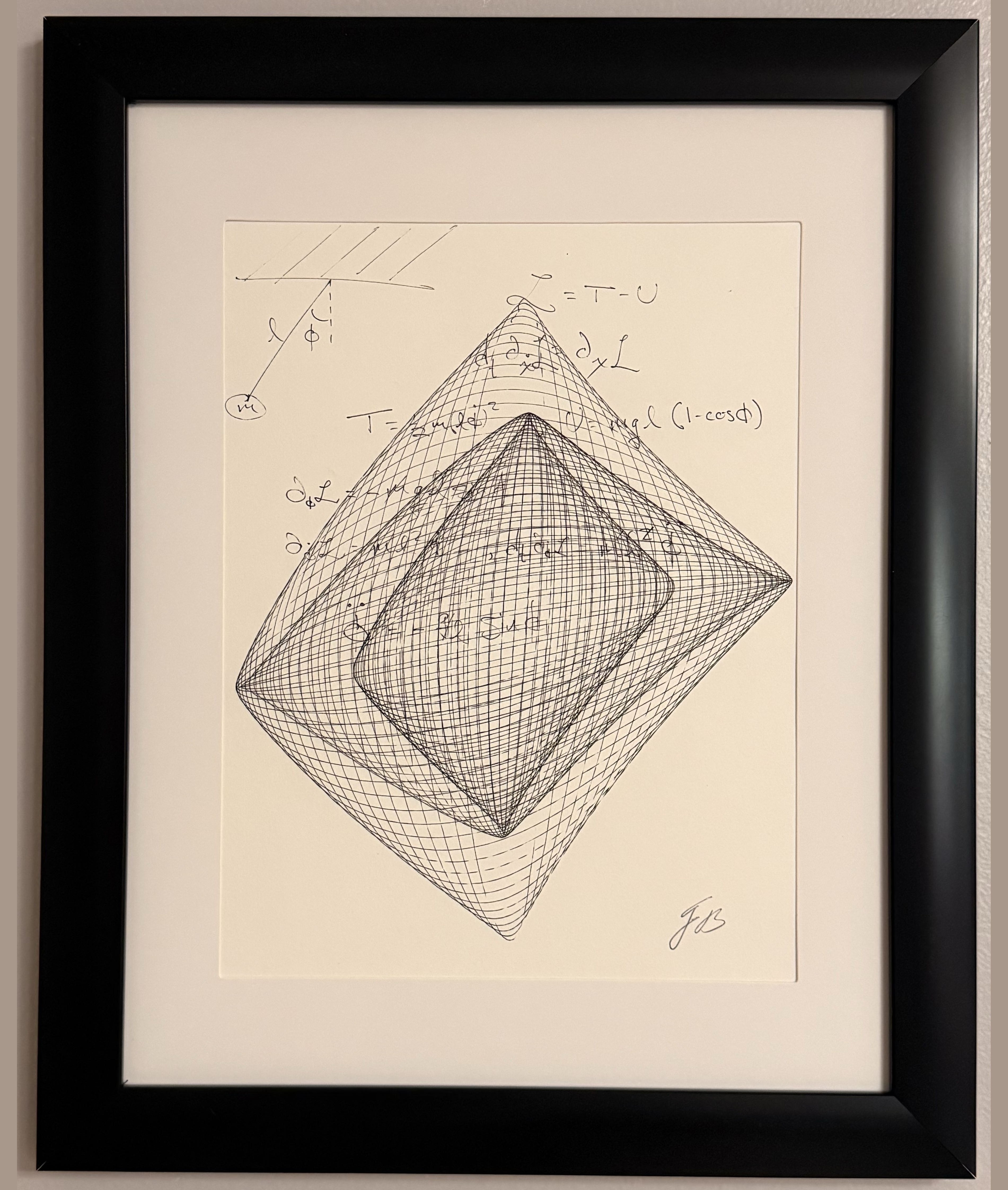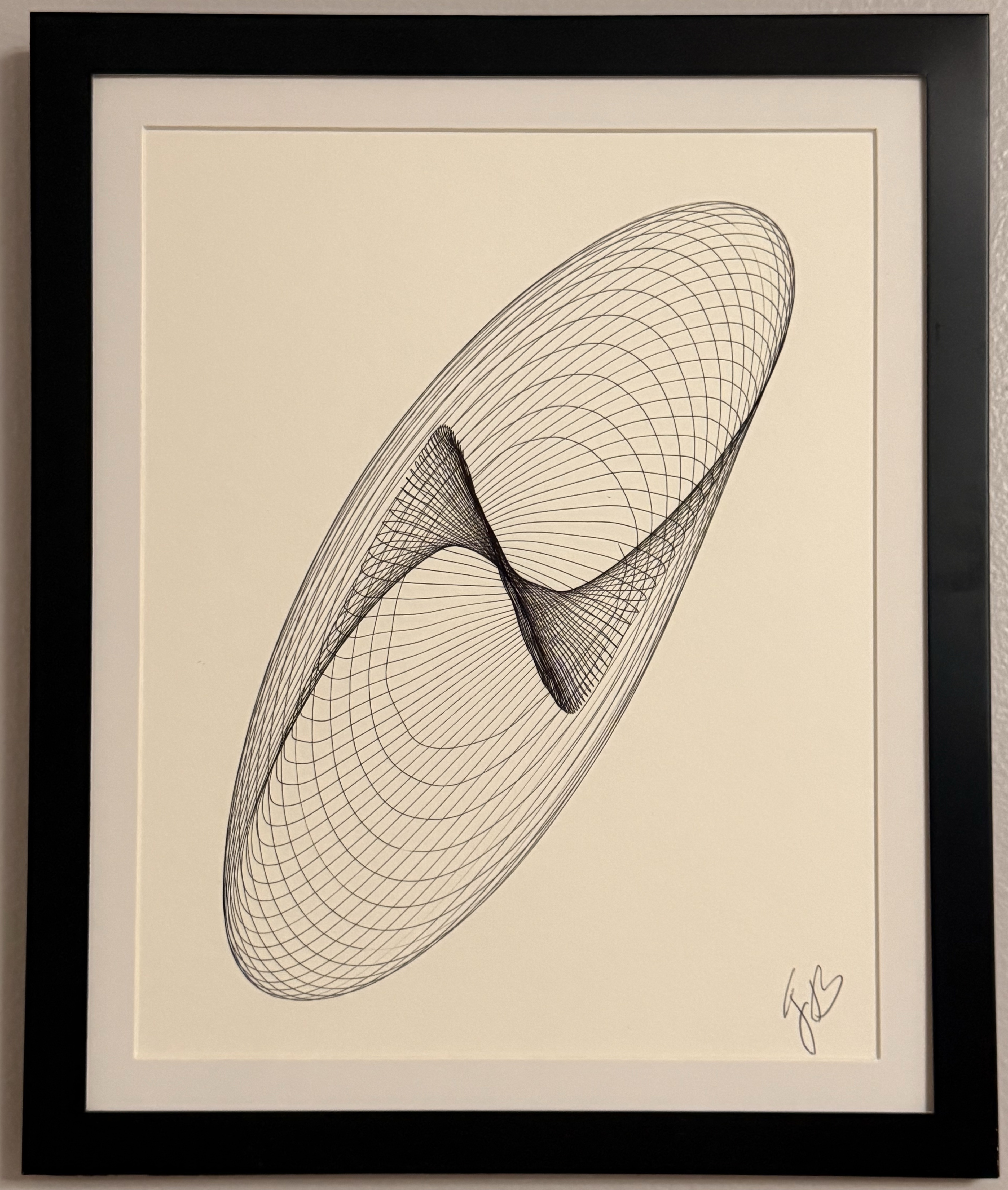
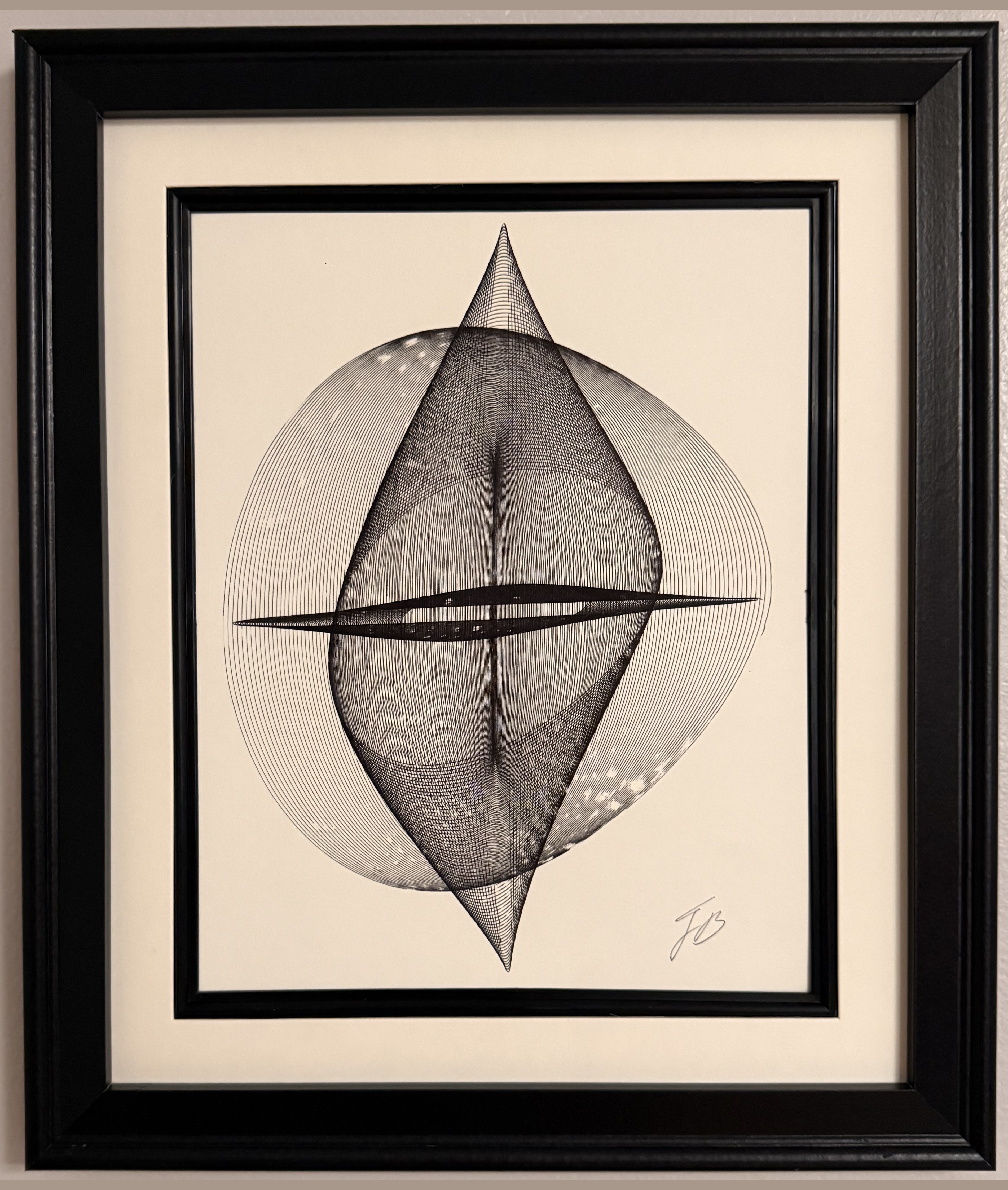
Someone left us breadcrumbs. These drawings are one of them.
The harmonograph is two pendulums and a pen. One pendulum drives X. One drives Y. The pen rides a 2-axis gimbal at their intersection, and when you release both at once, what happens next is entirely determined by the ratio of their frequencies and the phase angle between them at the moment of release. You don't draw the curve. You set the conditions and let go. What emerges was always going to emerge — you just had to build the machine to see it.
The builds started after encountering the Quadrivium — a book that doesn't read like a book. You don't go through it front to back. You open it when you've earned it, and it shows you what you need. The wave function collapses on contact. The harmonograph came out of one of those moments: a page on Lissajous figures, the geometry of two frequencies in conversation, and the sudden certainty that this needed to exist physically.
The pivot problem came first. Most harmonograph designs bolt to a dedicated frame — heavy, fixed, committed. The solution here was to design and print bearing pivots that clamp to any table edge, so the machine can be set up and torn down in minutes and run on almost any flat surface. Printed pivots, steel bearings, table clamps. The pendulums hang free on both sides. Two configurations run simultaneously: a lateral machine with 15 lb pendulums for long run times and high-precision Lissajous work, and a rotary table build with a custom 2-axis gimbal pivot that produces something else entirely.
Lateral and rotary are completely different beasts. The lateral machine is precise and almost scientific — you can approach specific ratio attractors deliberately, dial in a 3:2 or a 5:4 and watch the mathematics resolve on the page. The rotary machine is organic, unpredictable, more alive. The curves it produces don't look derived. They look discovered. Some ratios come out perfectly balanced. Others feel angelic. Some are frankly sexual. The machine doesn't editorialize. It just draws what the physics says.
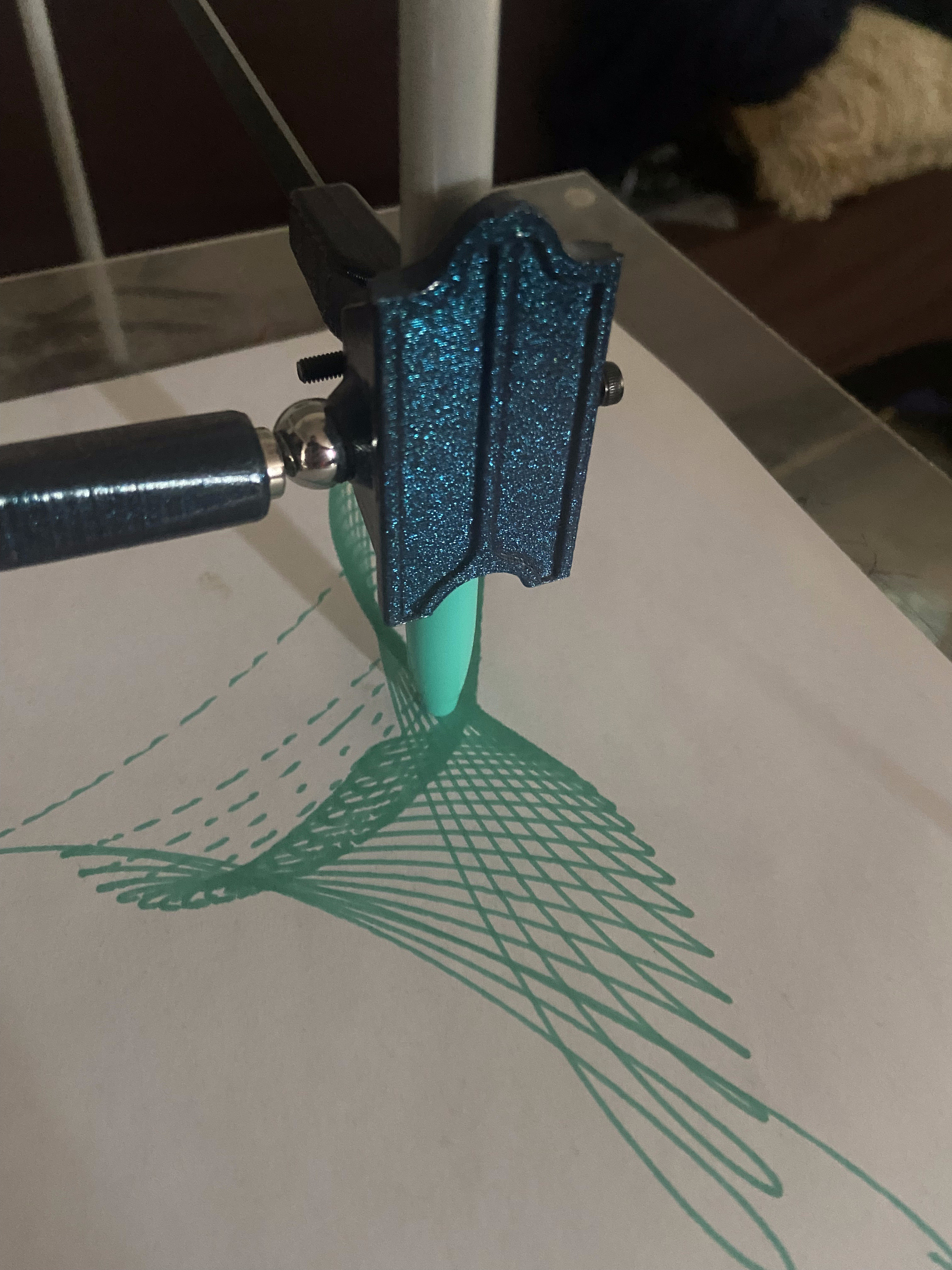
The Development Series is the record of systematic exploration: same machine, different initial conditions. Six drawings in the first set, framed. The second set is underway now with the high-energy lateral configuration. Parameters will be tracked going forward — frequency ratios, phase offsets, release conditions — because the drawings that stop you in your tracks deserve to be understood well enough to approach again, even if they can never be exactly reproduced.
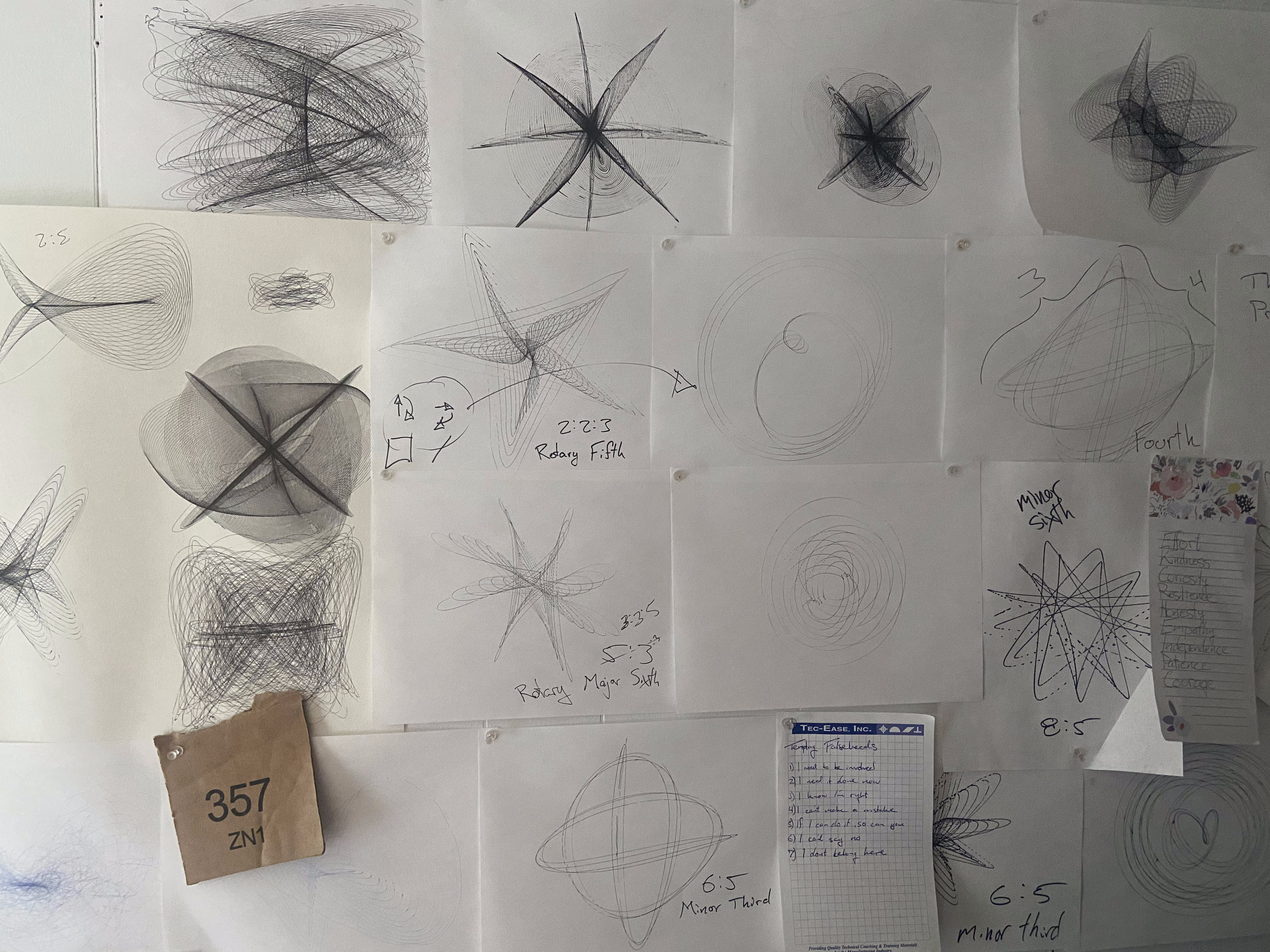
The paper and ink are still evolving. A large stack of rough sketches documents the exploration. A smaller set on heavier parchment stock points toward where this is going — the surface the drawings deserve, once the ratios are tuned in and the machine is fully understood. That work is ongoing.
Jules Antoine Lissajous described these curves in 1857 using a tuning fork and a mirror — he made the vibrations visible by reflecting a light beam. What the harmonograph produces mechanically is exactly what he observed optically. The same mathematics, different substrate. The universe has been leaving these shapes everywhere for a long time. In the geometry of orbits, in the harmonics of sound, in the proportions that recur across sacred traditions on every continent. The breadcrumbs were always there. The machine just makes them visible again.
Don't be afraid of what you see in these drawings. Someone put them there for you to find.
Every drawing begins with the same act: you position the pendulums, you set the phase, you lift your hands. From that moment the curve is already determined — the mathematics knows what it's going to draw before the pen touches the paper. Your job was the setup. The physics does the rest. This is not so different from how most things work, if you pay attention. You prepare the conditions as carefully as you can. Then you let go. What comes out is what was always going to come out. The only variable was whether you built the machine.